Dreams of His Father

A president's first trip to Africa:

So I believe that this moment is just as promising for Ghana - and for Africa - as the moment when my father came of age and new nations were being born. This is a new moment of promise. Only this time, we have learned that it will not be giants like Nkrumah and Kenyatta who will determine Africa's future. Instead, it will be you - the men and women in Ghana's Parliament, and the people you represent. Above all, it will be the young people - brimming with talent and energy and hope - who can claim the future that so many in my father's generation never found.
A speech full of rousing rhetoric, unique in the directness of its call to hold African leaders responsible.  Yet the mechanics of Obama's policy in Africa: USAID director and Assistant Secretary of State for African Affairs, have yet to be put into place.

Labels: ,

The Psychology of American Political Choice

Liberals are dismayed that Republicans can be 'duped' into supporting a vice presidential candidate with so little policy experience. Turns out this has nothing to do with being duped, but instead is about the disparate ways Republicans and Democrats make decisions. While liberals rest on John Stuart Mill (autonomy is sacred, therefore cruelty is the worst thing we can do), Republicans rests on sociologist Emile Durkheimer [here described by Jonathan Haidt]:

Durkheim...warned of the dangers of anomie (normlessness), and wrote, in 1897, that "Man cannot become attached to higher aims and submit to a rule if he sees nothing above him to which he belongs. To free himself from all social pressure is to abandon himself and demoralize him." A Durkheimian society at its best would be a stable network composed of many nested and overlapping groups that socialize, reshape, and care for individuals who, if left to their own devices, would pursue shallow, carnal, and selfish pleasures. A Durkheimian society would value self-control over self-expression, duty over rights, and loyalty to one's groups over concerns for outgroups.
Obama should describe liberal goals through Durkheimian principles if he wants to get swing votes.

Labels:

Suskind on Iraq

My good friend Greg Jackson was the researcher for Pulitzer prize winning journalist Ron Suskind's new book The Way of the World. If what Ron and Greg wrote in this book holds up under grand jury investigation, the President of the United States could be impeached.

The book claims that the CIA, on orders from the President, forged a letter between a former Iraqi intelligence chief named Habbush and Saddam which stated that Iraq and al-Qeada colluded to get uranium from Niger, and that 9/11 hijackers trained in Iraq. Suskind alleges that Habbush actually explicitly told CIA that Iraq had no WMD several months before the invasion of Iraq, and while publicly a wanted man, was actually a US-paid informant living in Amman.

Not only would this be the most outrageous government lie in modern history, but it would also be illegal. A 1991 amendment to a 1947 law governing the CIA forbids disinformation campaigns aimed at United States public opinion. There are no listed penalties for breaking this law, but one assumes it is an impeachable offense.

Suskind's main source, a CIA agent named Robert Richer, now denies his account. Others are speculating that the letter was forged, but it came not from the CIA, but from Doug Feith's Defense Intelligence shop, which would not be governed by the same laws.

By the way, the book is haunted with 'what might have been' if the Administration had actually finished the job in Afghanistan, focused on keeping America safe from loose nukes, and supported Bhutto and democracy in Pakistan.

Labels: ,

Hip Hop Portraiture at the National Gallery

Finding myself in DC with a few idle hours yesterday afternoon, on a tip from Chris Blattman I checked out the National Portrait Gallery's Hip Hop & Contemporary Portraiture exhibit. I was mostly curious which version of hip hop would be presented to the country alongside portraits of George Washington and Pierre L'Enfant.

Luckily, they chose hip hop's better side. The creators were pithy enough to showcase photography, painting, graffiti, film and poetry from artists like Supernatural, Prince Paul, Nas, Public Enemy, KRS-One, Jean Grea and the Roots. A great group of artists, but there was a noticeable lack of Mobb Deep ("they only 19 but they mind is older, when things get for real their warm hearts turn colder) and Big Pun feat. Fat Joe.

I was clearly not the only one bothered by the lack of Fat Joe. I saw one family of tourists walking through the gallery with a befuddled look. After a few moments, the father proclaimed, "These aren't the Civil War portraits!"

Labels:

AFRICOM, the American Military and Public Diplomacy in Africa

For those in DC tomorrow, my dear friend Vanessa is organizing the Annenberg Washington Series:

AFRICOM, the American Military and Public Diplomacy in Africa
Tuesday, March 18th, 2008

In 2007, the U.S. established a new military command for the continent of Africa. According to the Department of Defense, AFRICOM recognizes "the emerging strategic importance of Africa, and recognizing that peace and stability on the continent impacts not only Africans, but the interests of the U.S. and international community as well." Led by USC Annenberg journalism and public diplomacy professor Philip Seib, author of the forthcoming The Al Jazeera Effect: How the New Global Media Are Reshaping World Politics, this program offers the first thorough, independent examination of AFRICOM, which promises not only to reshape America's strategic approach to Africa, but also will redefine the role of the military in public diplomacy. Areas for discussion include soft power and American strategy in Africa, the relationship between the military and foreign policy agencies, and African responses to this initiative. 4 p.m., University of Southern California Washington Office. 701 Pennsylvania Avenue, N.W. Washington, D.C.

Labels: , , ,

Wednesday Links 2.5.07

View from the Daphne Hotel-Istanbul, via Argenberg's photostream

In Washington, Michael Dirda writes about Vermeer's Hat, which describes how at the dawn of globalization, "the lure of China's wealth haunted the seventeenth-century world."

In London, Tom Barnett explains the continental aspirations of U.S. Africa Command.

In New Haven, Chris Blattman lists an excellent African reading list.

In Cambridge, eon: dean of cyberspace gives us something to ponder.

Labels: , , ,

2007: A Reflection

For most of 2006, I lived in Africa helping to run a small NGO, Global Youth Partnership for Africa (GYPA), and working for USAID. 2006 marked the last of several years that my work has focused nearly exclusively on transitional justice and reconciliation in northern Uganda.

2007 was a wonderful year of transitions. I moved from Kampala to the DC area (briefly) and then to Cambridge/Medford, MA. Predictably for someone in their first year of graduate school, my work shifted in focus from practice to academia. I wrote a lot about Internet & democracy through my work at Harvard's Berkman Center, and found my way around the Fletcher School.

Reading through this year's blog posts, I found that they very much reflect my change in focus, though there are still a few good tales from Africa. Here are some highlights.
---
Before I left Kampala, Rebekah and I managed to leave our mark on the Ugandan blogren. I wrote alot for Global Voices, and we started the Uganda Blogger's Happy Hour and the Best of Blog Awards.

I managed to get in some fitful arguments about the state of the global/local soul, what American youth can accomplish by working in Africa, and whether Uganda should send troops to Somalia.

In Cameroon, I had epiphanies with American students in Limbe, ran up mountains in Bamenda, and witnessed the emergence of the Cameroonian film industry in Yaounde. In Cambridge, I walked the streets with nostalgia for hot summer nights.

I've been fortunate to be blessed with health, good family and friends, and time to reflect. Wishing you all the best in a new year.

Labels: , , , ,

Notes on Transcendentalism

For the past three winters, late December has only meant one thing: preparing for a trip to Uganda. For the first time since December 2004, I've had the pleasure of hibernating in my parent's house in the DC suburbs and spending a few weeks with family and old friends, doing miraculously little. The first non-academic book I picked up was Philip F. Gura's new American Transcendentalism.

Transcendentalism was one of my first intellectual interests, but I've thought very little about it since moving to New England. Gura's work is a history, and he does an exceptional job showing the movement's two distinct strains of thought. The first, embodied in Emerson and promoted by Thoreau, focuses on self-reliance. The second, represented by George Ripley and the Brook Farm utopian experiment, emphasizes social welfare and equality.

Why is Emerson's work now what the movement is remembered for? While Emerson was the most public of transcendental intellectuals, Gura explains that the North winning the Civil War ushered in the Gilded Age, when focus on self-reliance and capitalism canonized Emerson as a national bard. In a sense this has been America's guiding value ever since.

It seems to me that the struggle between self-reliance and social justice should be the chief public struggle of any modern age, and it’s fascinating to read about how earlier generations of Americans faced the same issues we do.

Labels:

Poker, Law and Diplomacy

I met Harvard Law Professor and Berkman Center founder Charles Nesson after ineptly trying to carry a fax machine on my back to his house while riding a bicycle. Predictably, I fell over, and arrived at his front door, the fax machine still intact, covered with scrapes and bike grease. His wonderful wife took me in and cleaned me up, and I subsequently learned about Professor Nesson's latest quest to use poker to teach strategic thinking in business, law and as of today, international relations. To be honest, I've never been a huge poker player, but I'm fascinated by the concept of games teaching serious life lessons. If you are in the Cambridge/Somerville area today at 12:30PM, join us for good Thai food and better conversation.


What can
POKER
teach us about
LAW AND DIPLOMACY


The Clash of Civilizations and International Trade Law Through the Lens of a Card Game

A Fletcher Roundtable with
Professor Charles R. Nesson
Weld Professor of Law, Harvard Law School
Founder, Global Poker Strategic Thinking Society

Wednesday, November 28th, 2007
12:30PM, The Fletcher School, Mugar 235
Thai food will be served

Sponsored by the Fletcher International Law Society and the Global Poker Strategic Thinking Society
Contact Josh Goldstein at joshua.goldstein@tufts.edu or Sam Feldman at samuel.feldman@tufts.edu for more information


For recent articles about this new initiative...
High Stakes: A Harvard Professor Puts an Academic Face on Poker (Boston Globe 11/5/07)
http://www.boston.com/ae/games/articles/2007/11/05/high_stakes/
Poker Just a Game of Cards? Don't Bet On It (Tufts Daily, 11/8/07)
http://media.www.tuftsdaily.com/media/storage/paper856/news/2007/11/08/Features/Poker.Just.A.Game.Of.Cards.Dont.Bet.On.It-3087447.shtml

Labels: ,

The Fierce Urgency of Now

Andrew Sullivan, an incredibly thoughtful conservative Catholic, writes in the Atlantic that an Obama presidency is the only way to transcend the bitter divide in of the Baby Boomer generation. His piece is hands-down the most persuasive argument for an Obama Presidency.

Money quote:

"But if you sense, as I do, that greater danger lies ahead, and that our divisions and recent history have combined to make the American polity and constitutional order increasingly vulnerable, then the calculus of risk changes. Sometimes, when the world is changing rapidly, the greater risk is caution. Close-up in this election campaign, Obama is unlikely. From a distance, he is necessary. At a time when America’s estrangement from the world risks tipping into dangerous imbalance, when a country at war with lethal enemies is also increasingly at war with itself, when humankind’s spiritual yearnings veer between an excess of certainty and an inability to believe anything at all, and when sectarian and racial divides seem as intractable as ever, a man who is a bridge between these worlds may be indispensable.

We may in fact have finally found that bridge to the 21st century that Bill Clinton told us about. Its name is Obama."

Labels:

First Month at Fletcher

This week marks the completion of my first month at the Fletcher School, and I've done remarkably little blogging. In a way, that's a testament to the fact that I am happily consumed by the breadth and depth of whats happening at the school (and at the Berkman Center). The major task of the month was jump starting my right brain after a long dormancy. Taking Development Economics, Stats and International Political Economy means that I've had to do this in a hurry, and its been far more enjoyable than I've expected. However, I'm making sure I'm not running too far from my old haunts. I've got a paper coming on the factors that correlated mobile phone use and pro-poor growth in developing countries, and whether any of those factors can help predict the ability for computer use (a la OLPC) to have the same effect on growth.

During the first week of school, Dan Drezner, political economy expert and Fletcher's most prolific blogger, gave a convocation speech. The speech made light of how the blogosphere challenges the status quo of the professional foreign policy community, and then urged Fletcher students to also not passively accept the wisdom of foreign policy elders. It was a wonderful example of a difficult skill that many in Fletcher are quite good at: leveraging credentials to artfully take stabs at established ways of thinking. This is the type of school where one could, hypothetically, bring an erstwhile and inspired Harvard Law Professor to talk about using poker to better understand strategic thinking in international relations.

Labels:

World Travelers for Obama

I've never actively taken part in a national political campaign before. However, its obvious at this point how important the presidential election is. My first contribution is a bit of writing and the creation of a group called 'World Travelers for Obama', available on Facebook and My.BarackObama.com Here is the group description:

------

For those who recognize that we need a President who is informed by a "lifetime of living overseas, having family overseas, being able to see the world through the eyes of people outside our borders."


If you know that an international perspective is crucial to solving the complex problems we face in the world, please join us.

-----

Here is the article I wrote as a first blog post on My.BarackObama.com, available here.

------

A few days ago, the Obama campaign released a small news item from ABCNews.com that few other mainstream or online journalists picked up. The overt message was not surprising or particularly interesting. Obama had claimed, in front of a closed door, off the record gathering of media elite at the Time Warner Building in Manhattan, that he had better foreign policy judgment than any other candidate.

However, the way he justified this statement, in a presidential race that featured a First Lady, a Vietnam Prisoner of War and a Senate Foreign Relations Chairman, was fascinating. Obama claimed he had the best foreign policy judgment because of a “lifetime of living overseas, having family overseas, being able to see the world through the eyes of people outside our borders.”

No presidential candidate in history has every taken the ‘I’m just a regular guy’ approach to foreign policy. As someone who is about to start a Master’s degree at the Fletcher School of Law and Diplomacy, an institution that trains professional diplomats, I should be skeptical of this kind of statement. But I’m not. It’s apparent to everyone at this point that the disastrous momentum caused by our current administration’s misadventures will take leadership, courage and creativity to turn around. What follows from this thinking is that we need a president who truly understands that culture and history are powerful forces that should not be an afterthought in foreign policy decisions, but primary considerations for the effectiveness of our policies, our own security, and the security of the nations we are acting with or upon.

Traveling, and more specifically, having personal relationships and friendships with people overseas, is crucial to understanding this fact. I became a student of international affairs after I had become a student of travel, learning most prominently from five trips to Africa, where I came to recognize that my friends were part of larger, richer cultures and traditions that were important to understand before we could even begin to discuss America’s role in their nation. Now, as a student of how and why nations wield power in an international setting, I keep in mind what I learned from my friends in Uganda, Rwanda, Tanzania, Cameroon and elsewhere.

In this sense, what Obama said to this closed-door gathering was remarkable. He recognized that intimate knowledge of a place and its people is the stepping-stone for decisions about our role in the world.

Labels:

In Praise of Hot Summer Nights and Seeing Your Name in Print

Unlike blogging, for which seeing your name in print is simply a product of how much you are willing to write and self promote, getting by the banshee gatekeepers of major publishing houses is still a epic task.

Yesterday, for the first time, I saw my name printed in a work from one of these wily publishing houses. I was mentioned in the acknowledgments of Benjamin Barber's 'Consumed: How Markets Corrupt Children, Infantilize Adults, and Swallow Citizens Whole,' published this year by W.W. Norton.

I did some initial research for this book for Ben, mostly in the NYU Library overlooking Washington Square Park, in the summer of 2003. I hadn't expected my name to be mentioned, but a friend called me when I was on the way to Cameroon saying that he was in a bookstore and saw my name among those acknowledged.

After the trip, settling back in to Cambridge, I finally got around to going to the Kennedy School library to pick up the volume and see for myself. I have to say, its quite nice to see your name in one of those properly bound, hard back books (though I haven't read it yet.)

After picking up the book (oh, what a gorgeous day it was) I sauntered through Harvard Square, up Mass. Ave towards my house, my mind was wandering back to that fantastic summer of 2003, when I was 19 and living in Manhattan. It was a maniacal summer, hot in any number of ways. I was living in a 17th floor apartment (overlooking the other corner of Washington Square Park), dating an (aspiring) actress named Elizabeth, and doing research for a real life writer. Elizabeth had grown up in Manhattan, and family friends let her stay in her own apartment in Hell's Kitchen, so we would go up on her roof (a few blocks from Times Square) with good friends, tell stories and make up rhymes.

In honor of a past summer in New York, a current summer in Cambridge, and the fact that here in the blogosphere we can still publish rubbish, I hereby present the first (and only) rap lines I've ever written, conceived on a hot, New York summer night:

"I was up on the roof
spittin' vernacular truth
wise words interplayed
like we're on a verbal raid
eye's towards Manhattan
our lyrics they were crackin...'"

jyea.

Labels: ,

Fish Heads and Samurai Swords

I moved up to Cambridge, MA, last weekend. Until I can move into my proper place in June, I'm staying in the room of a Russian poet who is visiting his wife and children in Siberia. The room has brown walls and the incurable smell of old books. Here are just a few things I found when I moved in:

- two and a half foot samurai sword
- small, dried fish head tied to a string hanging above the desk
- early 19th century Siberian hunting rifle

I put my bags down, looked around, and then went down the street to buy my first Red Sox hat.

Labels: ,

The Global Soul vs. The Local Soul

I read with interest Ethan Zuckerman's recent piece 'The Moving Circus, the Post-National, the Global Soul and the Xenophile.' I agree with Ethan's central point that "the future, in a very literal sense, belongs to the post-national, the Global Souls, the economic migrants. They're the best placed to create solutions to global problems, to invent new products for global markets, to build bridges and understanding between different nations."

I have been an advocate for the Global Soul since 2002 when I helped host the first annual 'Interdependence Day' at the University of Maryland. However, I have always found the Global Soul to be an incomplete concept. To understand this, I want to look at a concept that I will call, for expedience sake, the Local Soul.

The Local Soul is someone who devotes their public life to a local community, a place they can touch or feel. Local Souls can be teachers or, in my mother's case, a county government employee in an emergency social service that helps poor people who are facing eviction or improper treatment from their landlords. My mother told me an anecdote this weekend that I think illustrates the value of being a Local Soul.

My mother spoke of a 31-year-old woman with two jobs and several serious health problems who came into her office for housing support because this woman's mother, who was her main source of economic support, had recently passed away. This woman had nowhere to turn and was facing homelessness. My mother, along with several associates, sat her down and advised the woman how to navigate the tricky local government bureaucracy to give her support in her job training, housing and medical treatment. Afterwards, they hugged emotionally, because this woman had realized that these caring people had given her another chance.

This is to say that what the Global Soul misses is both sentimental and pragmatic. The pragmatic challenge is that in the abstract sense, eliminating suffering faces the same barriers everywhere. However, in real terms of making peoples lives better, one has to deeply understand the local environment. Secondly, the Global Soul lacks a sense of what German
sociologist Albert Tonybee called gemeinschaft, a sense of community defined by its strong bonds and kinship (contra gesellschaft, or society, which connotes simply co-existence). Technology can mitigate the effects of this sentiment, but I don't believe it can eliminate the sentiment completely.

However, what Ethan is saying when he talks of zenophilia, is that being a Local Soul is no longer enough. We know that our (local) way is not the only way, and for personal and creative reasons it is necessary to reach beyond the bounds of the Local Soul. This is absolutely true, and perhaps what has attracted me to the Global Soul from the start. How do we balance this tension?

Labels: ,

Of Trains and Boston

I took the train to Boston this weekend to find housing for my big move to Boston at the end of April. I'm incredibly excited to be interning for the summer at the Berkman Center for Internet and Society at Harvard Law School and then attending the Fletcher School of Law and Diplomacy at Tufts for a two year masters program.

Since I suppose I'll be doing the Washington-Boston trip frequently, I want to clarify my stance as a die hard train rider. Maybe its the marathoner in me that prefers the 8 hour train ride to an equally priced 1 hour flight. I find trains to be a unique way to gratify my opposing needs of wanting to be constantly moving and to have a quiet place to read, write and think. The scenery is great. You get everything from the huge metropolis to the underdog mill town.

My housing mission was a success. I'll be moving into grad school digs in Cambridge near Porter Square. I'll be living with an adventurous Russian writer from a prominent Soviet dissident family who traveled around the world to write a poem and kindly offered me a place to stay if I was ever near his farm in eastern Estonia. I felt great running in Cambridge, up and down the Charles River, basking in the first hesitantly warm days of the New England Spring.

For now only a word about my upcoming years at Fletcher. Of the 49 countries represented at Fletcher in the incoming class, there is no one from Uganda. I'll do my best to represent.

Labels: ,

This is a Criterion

photo via Richard Distand (Facebook)
Dear Uganda:

This is a road race criterion. Crazy young lads get dressed up in space alien suits and sprint around a short road course at 35 miles/hour right up on each other's back wheel. They make hairpin turns and occasionally crash violently. Their bikes are both devastatingly elegant and rather dainty; they are super fast, efficient, aerodynamic but unable to handle the smallest pot hole. The race was in a parking lot on a Sunday morning at the University of Maryland (go Terps!), so they didn't have to worry about running into matatus or boda bodas. In short, this is not the bike you would want to take on a trip from Kampala to Capetown.

Well, time to get my space alien suit on and go for a ride.

Labels: ,

This Is Snow

Dear Uganda:

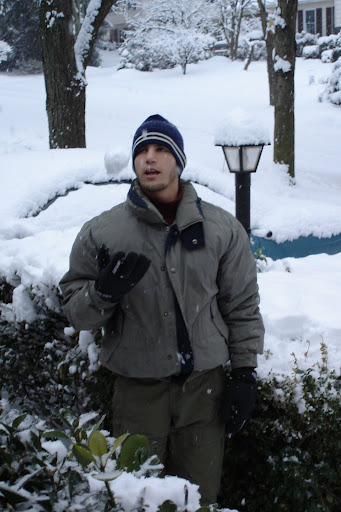
This is snow. Saturday night the roads were clear and I was taking in the happy sounds of Aphrodizia at an intimate space in DC. When I woke up Sunday morning, the Washington Post and New York Times Sunday editions were buried under six inches of fluffy fun. The snow was light and wet, perfect for crafting snowballs and building snowmen. We even saw an eight foot tall igloo in a neighbor's front yard.
Missing you all. Josh

Labels: ,

Some Work at U. of Maryland

Today I'm starting a new job at the University of Maryland. For the spring semester, I'm working with several different offices in Campus Affairs who are broadly charged with increasing the level of civic engagement at the University, both inside and outside the classroom. I'll be mostly working on ensuring that the web space for these projects is relevant and helpful to accomplishing these goals.

Since ultimately I'd like to be working (vaguely) with how IT can help communities in the developing world, it should be an interesting few months exploring how local communities (in the US) are using the internet to promote (both local and global) civic engagement. Maryland is providing some snappy leadership in this field, most notably the J-Lab: Institute for Interactive Journalism, whose work I have been following closely. U. of Maryland is also home to Peter Levine, one of my favorite bloggers, who writes alot on youth civic engagement and occasionally internet related projects.

Speaking of good things in the DC area, I have been pleased with the development of the local music scene since I've been gone. Rob Garza, from the legendary DC based Thievery Corporation, has a stellar new group called Dust Galaxy. They have a fantastic mix of the classic Thievery downtempo sound and indie rock glamour. Playing keys for the group, also from the DC scene, the lovely and charming aphrodizia, who lends the group some sultry, ambient sound. I heard about them too late to catch their Thursday night show at 9:30 Club, but surely they will be back.

Labels: ,

Missing Kampala Running

Running in Uganda may have had its share of hazards: horrific carcinogenic air, traffic with no qualms of taking up both lanes and any curb space, waist deep potholes and the occasional maniacal meat truck. All the same, the extremity freezing, grey skies, North Polesque weather I just ran in in Washington D.C. makes me miss my Kampala runs.

Labels: , ,