I've moved!
You can now find me at jkgoldst.tumblr.com

Labels: open data, open development, tanzania
 topfentorte, a german delight
Two bombs shook Uganda's capital last night in the middle of the World Cup finals match. While I was safe at home in Nairobi, the incident brought back fragmented memories of a peaceful, quiet town. I spent over two and a half years in Kampala, a place where I grew in many important ways.
The attacks are all the more dreadful when one remembers that Kampala is one of the few African capitals where it is safe to walk alone at night, where violent crime is nearly unheard of, and dreadful traffic is a relatively new (and not yet a permanent) facet of life. I spent a considerable number of nights at the Rugby Club and Ethiopian Village, where last night's tragedy took place.
Kampala's Rugby Club is a sprawling bar, adjacent to the pitch, where many of Kampala's college students come to hang with their buddies. If Uganda had fraternities, this is where they would throw their parties. Here the smart set drink Nile Special with reggae and hip hop blasting in the background. On weekend days the same crew watch rugby, collars popped to block the sun. Just last summer at the Club I saw Egypt pounded Uganda on a sultry Saturday afternoon.
Across town Ethiopian Village, down the road from the American Embassy, is in Kabalagala, the Las Vegas of Kampala. The restaurant, one of the half dozen or so Ethiopian restaurants in the area.
Labels: east africa

If you've spent time around the technology scene in East Africa over the last few years, chances are you've recognized that there is something special happening. Programmers, graphic designers and bloggers are creating new applications, content and the voices of a new generation of East Africans.
On behalf of the U.S. Department of State, the *iHub_, Appfrica Labs, and SODNET, we welcome your participation in Apps 4 Africa (@apps4africa) a competition that celebrates the idea that the energy, optimism and technical acumen of East Africa's technology community can help change the way we solve big social problems, amplify the voice of marginalized communities, and lower the barriers to public participation in the region.
From July 1st to August 31st, we welcome citizens to submit ideas that technology can help solve, and challenge technologists to build tools that lead to a better world. The top applications will receive cash, cool gadgets, and the chance to hob-nob with our judges panel of technology and civil society luminaries. Today, we are particularly pleased to have Under-Secretary of State Judith McHale and U.S. Ambassador Michael Rannenberger join a group of civil society leaders and civic-minded technologist to launch the contest at the *iHub_ in Nairobi.
This is only the beginning. Over the duration of the contest, we will host events around the region that address a variety of technology platforms and activist themes. We'll also be encouraging collaboration between mentors from around the world and coders in the region. Whether you are a citizen, civil society leader or technologist of any kind, we hope you will join us in the Apps 4 Africa challenge!
Thanks!

Labels: east africa, geo

Labels: east africa, open data
In Niger, millet, a household staple, is sold via traditional markets scattered throughout the country. Some markets are more than a thousand kilometers away from others with which they trade. The rollout of mobile phone coverage reduced grain price differences across markets by 15 percent between 2001 and 2007, with a greater impact on markets isolated by distance and poor-quality roads. Mobile phones allowed traders to better respond to surpluses and shortages, thereby allocating rains more efficiently across markets and dampening price differences. Mobile phone coverage also increased traders’ profits and decreased the volatility
of prices over the course of the year.
Labels: east africa, technology policy

Labels: east africa, technology policy, Wednesday Links
In The Atlantic, Adam Hochschild has a great piece on the story of Thomas Lubanga, a former DRC warlord who is the first ICC defendant to face a proper trial. When the ICC outreach team visited Bunia, the town in eastern DRC that has been ravaged by war, they realized that the scales of universal justice are quite similar to another set of scales more commonly seen in a town known for its gold deposits.
Nicolas Kuyaku, the cheerful, energetic Congolese who runs the ICC’s “outreach” office in Bunia, begins today’s session by showing 20 minutes of videos sent from The Hague. We see a brightly lit courtroom full of some two dozen people: solemn judges and lawyers in black robes and white jabots, an impassive Lubanga in a suit and tie in the dock, witnesses who testify about his use of child soldiers, plus a prosecutor, a defense attorney, and—an ICC feature loosely modeled after some European justice systems—a lawyer making statements on behalf of a group of victims. Something that must mystify the audience is the court’s logo, almost always in the upper right-hand corner of the TV screen: the scales of justice. To anyone in Ituri, they look like the small, handheld scales found in thousands of shops here that weigh little flecks of gold laboriously gathered from riverbanks by miners—a job some of those here today say they’ve done.
Labels: east africa
Mobile Web East Africa is a very cool conference taking place in Nairobi of Feb. 3-4. The event focuses on "harnessing the potential of the internet and applications on mobile devices," and could not come at a better time. The faster connectivity associated with the launch of the SEACOM cable is reaching Kampala and Nairobi, and the price point of new and smaller mobile devices is falling.
The conference has several key themes. To me, the most interesting questions relate to how consumers will experience the mobile web in East Africa, and what this will mean for social and economic innovation. For example:
What handsets, standards, networks and designs will allow consumers to successfully access the content and consume it?There are some fantastic speakers lined up, including Eric Cantor of Grameen Foundation, Vincent Maher of Vodacom South Africa, Agosto Liko of Pesapal, Jon Gosier of Appfrica Labs and Erik Hersman of Ushahidi.
How will the consumer be able to discover that content – through a portal, application, browser, search engine, advert, social network?
Labels: east africa, technology policy
I 2006, I was working for USAID in northern Uganda as the 20 year conflict in the region was winding down. While negotiators in Juba were sorting out a lasting peace, our group was convening community leaders from the various regions to discuss tricky disputes around issues like land re-settlement and water supply. This was challenging because northern Uganda is a vast place, and getting leaders from disparate regions together was a logistical nightmare.
Can mobile phones make meaningful dispute resolution more efficient? Paypal's Mobile Phone Jirga, a project supporting the rule of law in Afghanistan, seems to think so.
Labels: technology policy
This summer in Kampala, in between hazardously driving a Benz and awkwardly singing Kenny Rogers with the vice president of Kenya, I had an amazing opportunity to research and co-author a paper with nuero-scientist cum philanthropy feedback loop expert Marc Maxson. Marc is manager of performance analytics at Global Giving, one of the most important 'start-ups' in the marketplace for aid. In his spare time, he does things like write a 50,000 word novel in 30 days.
To better understand feedback loops, we each visited Kisumu, in western Kenya, to hang out with SACRENA, a project that received both traditional feedback [external expert evaluator] and more informal, experimental, web and mobile mediated feedback loops [Global Giving visitor postcards, direct email links between project beneficiaries and funders].
The resulting paper, “Real-time technology aided feedback loops in international philanthropy” was delivered at the International Social Innovation Research Conference at Oxford by Mari Kuraishi, GlobalGiving’s president. The paper is an early step in exploring some of the qualitative differences in the two types of feedback. The next exciting step is to pilot new and better forms of feedback loops between donors and beneficiaries.
Labels: marketplace for aid
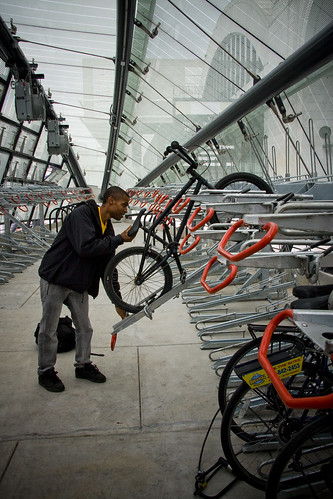 BikeStationDC, a stunning new facility at Union Station in DC, via BrooklynByBike
Labels: Wednesday Links
The practical work of moving foreign aid away from the planning and towards markets and networks is only in its infancy. In his fantastic Center for Global Development paper on Markets and Networks for Better Aid, Owen Barder provides a vision of what a marketplace and network for aid would begin to look like. The most interesting challenge to me is finding a replacement for price in the market metaphor. Owen seems to agree:
...there is no obvious analogue to price. Markets work by simplifying large amounts of information about preferences, costs, and effectiveness into a simple, transparent price signal. In the aid system, there are rarely explicit measures of the price of each output which would provide signals to producers and consumers.Improving the feedback loop between donors, project managers and aid recipients is the best way to create a proxy for price in aid projects. My friend and Fletcher colleague Chrissy Martin has a great piece about how groups are experimenting with informal, SMS-based feedback tools. In Put Up a Billboard and Ask the Community: Using Mobile Tech for Program Monitoring and Evaluation, Chrissy explores the experience of RapidSMS in Malawi, Global Giving and Twaweza in Tanzania, each testing SMS-based feedback mechanisms on various scales and in very different settings. The goal, she writes, is that "mobile technology can be integrated into M&E systems so that they are more participatory, useful, and cost effective."
Labels: east africa, IT for development
 Can institutions [be they international organizations, companies, universities, foundations or governments] enable innovation in local technology industries? We explored this question on a rainy Saturday afternoon in New York at the 'coded in country' session of the Open Mobile Consortium's Open Mobile Camp in New York.
Partner with Local Universities
Lucky Gunasekara of FrontlineSMS:Medic and Stanford University pointed to Nathan Eagle's Entrepreneurial Programming and Research on Mobiles project that partners with African mobile engineering department to strengthen capacity. challenge: ensure knowledge reaches beyond university-educated classes.
Break Down Barriers with Local Tech Industry
Chrissy Martin of the Fletcher School mentioned that in Tanzania, the most inspired, engaged, and talented programmers all worked at value added services companies. These are companies that charge premium rates for sending and recieving sports scores, concert tips and other local cultural content. Chrissy argued that there should be more cross-pollination between private sector talent and those working on M4D projects. challenge: find an incentive for private sector programmers to engage.
Convince Donors to Adopt a 'Coded in Country' Standard
Similar to a fair trade stamp of approval, what if the Gates Foundation declared that any development project with a coding element must be 50% coded in-country. To be sure, some projects already feel a need to hire local developers. Stephen Miller of the Ujima Project | Investigative Reporting for Africa, discussed how the group hired Appfrica Labs to do the coding for the project. challenge: in places where local capacity is not established, balance project goals with local capacity building.
Give Space for Informal Innovation Labs
Christelle Scharff, professor of computer science at Pace University, discussed the mobile development boot-camps she runs in Senegal. The goal is to create space and an incentive for young people to spend a week intensely tinkering with mobile solutions to community problems. This is a similar approach to Appfrica Labs 10,000 Hours project, which urges companies in Kampala to open their space to young people interested in digital technologies. challenge: ensure that peer-education ensures learning of fundamental skills.
Labels: east africa, IT for development, technology policy
Over at Many Possibilities, Steve Song just introduced the idea of a Fair Mobile Index: a measurement, akin to the Economist's Big Mac Index, of what mobile pricing regimes mean both for the average African user and mobile innovators who benefit from a generative market.
Steve writes:
I'm incredibly excited to follow, and hopefully to contribute to, the FairMobile research agenda. The editor of my Venture Beat article on Africa's SMS Crisis cut a critical passage that alludes to the frustrations I felt amongst innovators while I was working in Uganda:Evidence from the pan-African research network, ResearchICTAfrica, points to a remarkably high percentage of income being spent by the poor on mobile services. For low income earners across 17 countries studied, the average African is paying more than 50% of their disposable income on mobile services.
At the same time, mobile operators are posting impressive profits. Kenyan operator Safaricom generated over 900 million USD in revenue last year of which a staggering 40% was Earnings before Interest, Taxes, Depreciation, and Amortization ( EBITDA). Other operators are also posting impressive profits with most operators on the continent announcing year on year increases in revenue.
The startling contrast between the remarkable benefits of mobile infrastructure and the high price being paid for mobile services in Africa while mobile operators post record profits leads to the conclusion that more competitive mobile markets in Africa would lead to even greater social and economic benefit for all but especially the poor.
These [innovative mobile] services, however, represent a trickle of innovation where there should be a downpour. The source of this sluggishness is the “non-generative” structure of mobile phone networks. In The Future of the Internet and How To Stop It, Harvard Law Professor Jonathan Zittrain defines generativity as the ability for entrepreneurs anywhere, driven by any social or economic motivation, to quickly and cheaply create, test and deploy applications. Zittrain says that generativity is the key to the Internet’s rapid growth, and he worries that new web-based appliances, such as the iPhone, that can only be modified with the manufacturers consent, threaten this fundamental character. In other words, Zittrain fears that the Internet as a network is becoming more like the mobile phone: costly and closed.
Labels: east africa, technology policy
 Pigeon Sun, via Meg Rorison's photostream
Labels: Wednesday Links
Parallel to my thinking about the prohibitive pricing of SMS in Africa [see my recent piece in Venture Beat], I've been thinking a lot about how to harness the pervasive and utterly free practice of 'beeping' [which takes place when a user places a call and quickly hanging up in order to send an (often) pre-arranged signal to another user such as 'come meet me now' or 'call me back'].
I'm curious to explore how 'beeping' can be used to collect information and serve as a platform for mobile services? Here are two good ideas.
'Beeping' as Instant Feedback and Poll-TakingThere is an open question as to whether mobile networks would actively push back on a high-profile 'beeping' project because it leverages their networks for free. It is important to note, however, tha most networks could probably handle over a million 'beeps' without significant use of their capacity.
Imagine you are in Pader, one of the major towns in northern Uganda. During a drought, your community receives food aid in six different locations from six different donor agencies. As you walk into town, you see a billboard that asks: which of these six locations serves you best? Each location is tied to a mobile number. To vote, you just beep the appropriate number, and the votes are tallied by a simple piece of software on a computer attached to the six different phones. [the software would check for repeat numbers, ect] The same system could be used for conducting local elections.
'Beeping' as Coded Messages
Last night, I was re-watching Ashifi Gogo's talk earlier this year on GSM Networks at the Berkman Center. In his discussion of how asymmetric encryption is leveraged for his brilliant m-Pedigree project, he mentions that the next generation of such services may involve 'beeping.' For example, imagine you are planning your drive to work across central Accra in the morning and you wonder how much traffic is on the road. Gogo asks what if there was a short-code you could beep, and get a coded beep in response- one beep means the road is free of traffic; two beeps mean you better walk.
Labels: east africa, technology policy
In college, when my thinking about communities first began to mature, I noticed the obvious discrepancy in Washington D.C. between the political elite who occupied a significant part of the northwest section of town, and remainder of the denizens, whose lower and lower-middle class communities lacked access to things like hospitals and super-markets. Since then, I've been a fan of community projects that put young people from communities with few resources in a new setting with a new vocabulary and a fresh take on the world. These shifts often provide the spark for new passions and new ideas to take home and expand.
For this reason, I'm excited about Appfrica Labs's new 10,000 Hours Initiative, described by Jon Gosier here:
I find this to be a remarkably creative act of sharing, and one that can be highly successful with few resources other than a willingness to be occasionally generous with ones time.Appfrica’s 10,000 Hour Initiative is aimed at offering a space for younger people to pursue their passions alongside professionals working in the field. The concept is very much inspired by the 826 National Project, which offers kids in the U.S. an after school hours community center where they can work alongside professionals who act as tutors and mentors. The name comes from Malcom Gladwell’s OUTLIERS, where he theorizes that it takes about 10,000 hours of practice for anyone to become truly exceptional at doing something. Of course we want to help offer those hours.
[...] The first space will be at my office in Kampala where I’ll encourage students interested in programming, new media and blogging to come by after school hours to spend a bit of extra time either working on their homework or learning new things from myself and my staff. Here they’ll have access to our staff, our internet connection, books, our computers and other resources that they can experiment with.
Labels: digital democracy, east africa, technology policy
Labels: Wednesday Links
In High Tech Diplomacy (Newsweek) Evgeny Morozov writes that Silicon Valley tech firms could be a good conduit for public diplomacy.
Distributing Kindles to the four corners of the world would not only be a good gesture from Amazon, it would also help promote free speech. Kindle could end an era when visiting foreigners have to smuggle samizdat books in and out of authoritarian countries. It is a dream device for dissidents, all for $299.In 1963 Voice of America, the primary public diplomacy arm of the U.S. Department of State, translated and broadcast Martin Luther King's 'I Have a Dream Speech' behind the Iron Curtain, giving many people access to one of the most vivid narratives of the promise of democracy. However, American diplomats, and their counter-parts overseas, have yet to get public diplomacy right in a digital age.
Labels: Internet and Democracy
 the view from downtown Salzburg, Austria
Labels: Internet and Democracy, technology policy, west africa
An article I wrote this summer appears today on Venture Beat:
It would be easy to conclude that Africa is entering the golden age of mobile innovation. In Kenya, mPesa, a Safaricom service, allows users to send money anywhere in the country via mobile phone at very low rates. Next door in Uganda, rural users out of reach of the Internet can use a new SMS-based service from MTN, Grameen Foundation and Google to trade goods, search the Internet and query local reproductive health and agriculture information.
These services, however, represent a trickle of innovation where there should be a downpour. The source of this sluggishness is the structure of African mobile phone networks, which discourage entrepreneurs from quickly and cheaply creating, testing and deploying applications.
[read more...]
Labels: east africa, technology policy
I just moved to a fourth floor walk up in Williamsburg, Brooklyn and started a job with the UNICEF Innovations group. The group aims to leverage affordable hardware and open source software to both improve UNICEF's operations (they purchase over 1/2 of the world's vaccines) and empower young people. For me, this is a fantastic opportunity to explore both big intellectual questions (To what extent can large institutions learn from the African Digerati?) as well as fun practical questions (What is the best way to ensure that youth in Africa can participate in UNICEF campaigns with only Nokia 1100 phones).
Also, I have the pleasure of helping to moderate a HUGE event on Wednesday at the Berkman Center. Yochai Benkler, Amartya Sen, amongst others, are participating in Communication and Human Development: The Freedom Connection?, a discussion on the future of the overlap between digital technology and economic and social growth in the developing world.
Amongst the great essays written for the Public Project in anticipation for this event, Benkler, with his usual alactrity, gets to the bottom of things:
If the first generation of benefits of ICTs for development was captured by the image of fishermen calling different ports and negotiating the price of fish before they pulled in to port, so as to capture greater returns for their families, the next generation has to be similar deployment of the much more flexible and dynamic affordances of more powerful computational devices, cloud applications, and social software or organizational tools.Benkler recognizes this is not easy in the developing world setting, and goes on to present a clear dichotomy for action: either force the mobile networks to be more open, or figure out how to make more sophisticated technology more widely useful and available.
Labels: eas, Internet and Democracy, technology policy
 Joshua Goldstein is in search of the best route to bicycle from Kampala to Capetown.
goldstein [dot] joshua [at] gmail
Blogger Blog of Note
October 2006

The Role of Digital Networked Technology in Kenya's Post-Election Crisis
'Open Access' Internet Infrastructure in East Africa
The Role of Digital Networked Technology in Ukraine's Orange Revolution
Post-Conflict Development
Internet & Democracy
ICT4D
East Africa
West Africa
USA: East Coast
Global Voices
Off the Grid
The Fletcher School
Harvard's Berkman Center
Berkman's IDBlog
Fletcher Forum of World Affairs
My Heart's in Accra
John Palfrey
FLETCHERReflections
Harvard GOV Theory Review
Daniel Drezner
Theoretically Political
HLS International Law Blog
eon
ZamBoop
Global Poker Strategic Thinking
Jackfruity
Meg Rorison's Photostream
Porkchop Express
Peter Levine
Bicyclemark's Communique
Andy's Global View
Millenial Challenge
Africabeat
Communist Socks and Boots
En Un Minuto Argentino
Global Voices
My Del.icio.us
My Photostream
Current Posts
June 2006
July 2006
August 2006
September 2006
October 2006
November 2006
December 2006
January 2007
February 2007
March 2007
April 2007
May 2007
June 2007
July 2007
August 2007
September 2007
October 2007
November 2007
December 2007
January 2008
February 2008
March 2008
April 2008
May 2008
June 2008
July 2008
August 2008
September 2008
October 2008
November 2008
December 2008
January 2009
February 2009
March 2009
April 2009
May 2009
June 2009
July 2009
September 2009
October 2009
November 2009
December 2009
February 2010
March 2010
April 2010
June 2010
July 2010
July 2011
September 2011
October 2013

